
Iran
What I know about war, and why this one doesn't sit right with me.

Earlier today I wrapped up my final long effort before Zion in a couple of weeks. Three hours in Umstead. Feet moving, head somewhere else entirely. For most of that run I wasn’t thinking about my training or the race ahead. I was thinking about Iran. Not from a political standpoint, not really. More from the place inside me that spent years of my life in that part of the world and came home changed in ways I’m still figuring out.
So I’m going to spill it. All of it. Because I think I have something to say here that most people don’t.
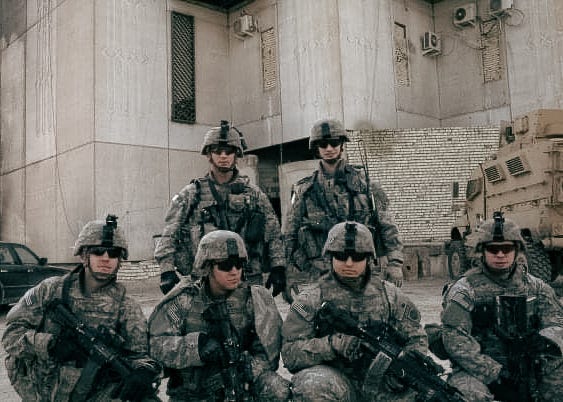
Nearly 20 years ago I enlisted in the US Army. My official job title was 13F, Forward Observer. In its simplest terms, my job was to call in air strikes, artillery, and naval gunfire onto enemy targets. I was one of the most lethal assets on the battlefield. In Vietnam, the average lifespan of a Forward Observer was seven minutes. Seven minutes. Because the enemy knew exactly who you were and what you were capable of, and they were coming for you first. I was damn good at what I did.
After boot camp I went through Airborne school and was assigned to the 82nd Airborne Division at Ft. Bragg in North Carolina. Within weeks of arriving I had two duffel bags packed and was loaded into the back of a military aircraft on a one-way flight to Iraq. Baghdad, specifically. It wasn’t until I landed at Forward Operating Base Taji that I learned I’d be going to COP Callahan, a remote outpost in the heart of one of the most violent neighborhoods in Baghdad, right on the edge of Sadr City.
We arrived under the cover of darkness. What I remember most is the moon casting light across the side of an abandoned building that my unit had seized a few months before I got there. Dark spots covered the walls. The next morning someone told me those were from the rocket strikes that routinely hit the building. We were not liked. This was my new home.
Iraq was a complete shithole. There’s no softer way to put it and I’m not going to try. But I was young and impressionable, there to serve my country, and I did what I was told and tried to do it well. It was my first real look at the world outside our protected American bubble. I got up close and personal with a version of life that most people back home couldn’t imagine on their best day. Some people loved seeing Americans in their city. Many did not. And it would take years for me to really understand the dynamics at play in that part of the world. What I came away with from Iraq was simple and it hasn’t changed. The mission to win the hearts and minds of those citizens was a waste of time. I still believe that with everything I have.
In 2011 I deployed to the eastern mountains of Afghanistan. Another shithole of a country, at least the parts I was in. People who wanted all of us dead. Not some of them. Most of them. They shot at us. They tried to blow us up. And, they succeeded at times. They made every single day a grind that wore you down in ways that are hard to describe to someone who hasn’t been there. It was also on that deployment that I knew with complete certainty I would never re-enlist. I was done.
Then came the day that broke something open in me that has never fully closed.
Two black bags on a table. I was told to grab the handle of one of them. Inside those bags were Sgt. Born and Sgt. Conrad, who minutes earlier had been shot and killed by an Afghan Army soldier. A soldier who was supposed to be on our side. Part of the mission. Part of the whole reason we were there, to build up their military so they could one day defend themselves. Instead he put multiple rounds into two of my brothers and disappeared into the crowd of protestors gathered just beyond our barbed wire perimeter.
The Blackhawk came in low and fast, dust kicking up in every direction. I lifted the bag, did my best to stay upright as the weight of what was inside and the weight of what I was feeling nearly buckled my knees. Loading it onto the helicopter, I set my hand on top for just a moment and said a few quiet words. I didn’t know if it was Born or Conrad. It didn’t matter. They had paid the ultimate price.
And for what?
That question has really bothered me ever since that day. What the hell were we doing over there? What was the goal? What did success even look like and who was supposed to tell us when we’d found it? Just hours before, these two men had been going about their day. Proud. Present. Doing their jobs and trusting that the mission they’d been handed meant something. And now they were going home for the last time, to families who didn’t know yet, to funerals that would happen on American soil while the country that sent them over argued about things that didn’t matter.
That day changed my perspective on war. Not just how I thought about the Middle East, but how I thought about the people who send other people to die.
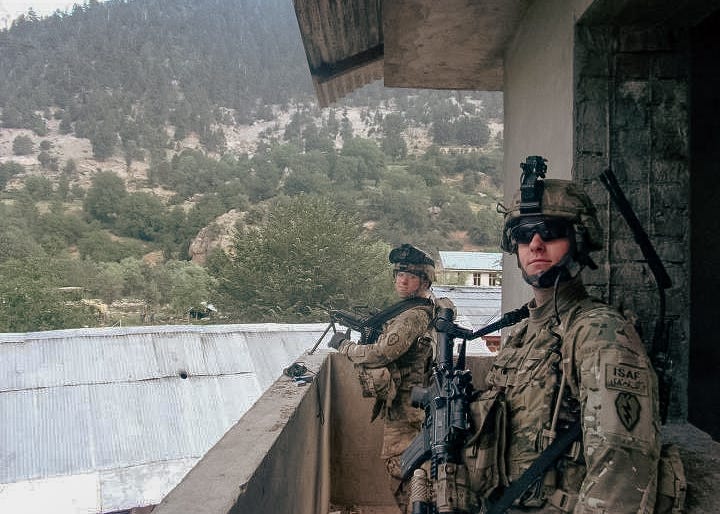
And now we’re doing it again.
When I heard that the 82nd Airborne Division was being mobilized in what looks like the beginning stages of a ground assault of Iran, something inside me went cold and then got really angry all at once. That was my unit all those years ago. The patch I wore when I loaded onto that aircraft to Baghdad. The same division that’s been showing up in the news lately for reasons that made my stomach drop before this even started. Seeing those maroon berets on the screen doesn’t feel abstract to me the way it might for someone watching from their couch. It feels like watching the next chapter of something I lived get handed to a group of kids who have no idea what they just signed up for. Fourteen years since I came home from Afghanistan and here we are, right back at the edge of the same cliff, about to jump off for the same reasons that never held up the first time.
Did we learn nothing from 20 years in Iraq and Afghanistan? Nothing at all?
These countries do not change. They haven’t changed in thousands of years. The culture, the religion, the tribal loyalties, the distrust of outsiders, it runs deeper than any military campaign can reach. We spent two decades and trillions of dollars and thousands of American lives trying to reshape two countries and we left them exactly as we found them. Hell, Afghanistan is run by the Taliban again. The same Taliban we were there to dismantle. And when we left, we gave them our vehicles, our equipment, our facilities. As a parting gift. To the enemy. To honor the sacrifice of every man and woman whose family buried them with a flag in their hands.
What did we accomplish? Someone tell me. I genuinely want to know.
And now we’re being asked to look at Iran and nod along like this time will be different.
Most of the people who are making this call have never carried a body bag. They’ve never sat in a helicopter with their hand resting on someone they can’t bring themselves to fully think about. They’ve never looked into the eyes of a local in this part of the world and tried to figure out in real time whether that person wanted to shake your hand or kill you. They’ve never come home and tried to explain to someone who loves them what it actually felt like over there. They make decisions from the other side of the world, from air conditioned rooms, with no skin in the game and nothing personal on the line.
That’s who is sending our next generation into Iran.
And the justifications have already started shifting and we’re barely into this thing, which tells you everything. First we were told we had to go save the Iranian people from their regime, the same people who have chanted Death to America for four decades. Then it was about toppling that regime and installing a pro-West government, which we have never once done successfully in that part of the world, not even close. Then it was the nuclear program, the same nuclear threat that Benjamin Netanyahu has been warning was weeks away from being realized since the mid-1990s. Thirty years of weeks away. Go look it up. And didn’t we obliterate that program six months ago? Weren’t we told that? Somehow they’ve rebuilt and accelerated it at a speed that defies basic physics.
Now it’s the Strait of Hormuz. The strait that wasn’t closed six months ago. The strait that sits in the exact theater of war we decided to start. We lit the house on fire and now we’re suiting up to fight the flames like we’re the hero of this story.
And through all of it, where is Congress? Where is the open debate? Where is the honest accounting to the American people of why we are preparing to send sons and daughters into a country on the other side of the world that did not attack us, that posed no existential threat to us here at home, that we are entering because of intelligence from the same partner who promised us Iraq had weapons of mass destruction?
I’m not naive about Israel. I’m not writing them off. But I am paying attention to the pattern.
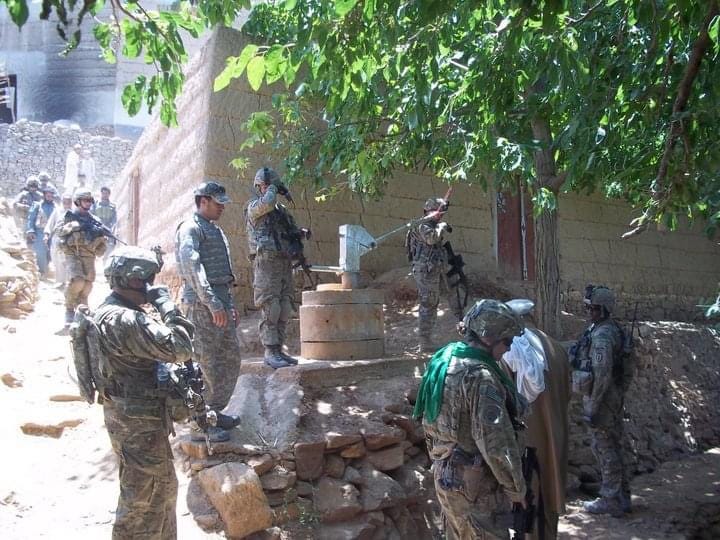
I know what war looks like. I know what it smells like. I know what it does to the people who fight it and I know what it does to the people who wait at home for news that may never come.
What I’m watching right now, from a country that I love and that I once put on a uniform to defend, is a nation sleepwalking toward something it doesn’t understand, led by people who have never had to understand it. The television will make it look one way. The press releases will frame it another. And somewhere over there, a kid who enlisted six months ago because he wanted to serve something bigger than himself is going to be handed a mission with no clear objective and told to go execute it.
And some of them won’t come back.
My hope is that common sense finds its way into this before it gets worse. Before more families get the knock on the door. Before more hands get placed on more bags and more quiet words are said in the middle of a dust cloud in a country that never asked us to be there.
But hope is a hard thing to hold onto when the people making the decisions have never had any reason to know what they’re risking.
The dirt, the sweat, the blood. It never gets on their uniforms.